Monday, June 28, 2010

Energy and Renewal

I have more energy these days. A LOT more energy. And because I have more energy, I’m more productive (I finished the first draft of my sermon this morning) I wish I could point to one reason why this is, but there are many factors.

But the bottom line is: this what I can do when I’m not depressed.

As many of you know I separated from my wife last November. And I knew I was emotionally depleted, but I figured that a few days in the gym per week and my daily green smoothie would help.

It didn’t. Around the beginning of Lent I fell into a deep depression. The worst of my life. I worked minimal hours, just getting the basics done. Then I’d spend a lot of time in bed. I’d spend time with the girls, but would sit them in front of the TV. I stopped reading. I couldn’t concentrate. Life sucked.

One day around Easter I stayed in bed until 3:25 pm. The only reason I got dressed was because I had to pick my daughter up from school and obviously couldn’t abandon her. That’s when I realized I needed help. So I made an appointment with a counsellor.

He was awesome. He recommended the book Feeling Good by David Burns, and it opened my eyes to what I was experiencing and have me the tools to facilitate my healing. After two months (or so) of hard work I found that my energy had returned and I could see the world differently. My sense of self gained strength and could see new possibilities for the future.

I’ve since returned to the gym and started a healthy eating program. Some parishioners and friends have offered incentives (I’m REALLY looking forward to losing the first 10 pounds!) and so I feel like my life is finally coming back together. It feels like I’m creating my life rather than reacting to life as it’s happening to me. For the first time in a long time, I feel like I have some semblance of control.

Ministry has become a joy again. I feel like my old - but renewed - self.

That’s why I can write two sermons in one morning. But I’m sure the green smoothies play a part.

Sunday, June 27, 2010

Sermon: Pentecost 5C

NB: Had a wee bit 'o help from Willimon's Pulpit Resource


When we're trying to recruit new people into our church, how do we do it? What tactics do we use?

Do we say that we're a friendly, welcoming, bunch? Do we go out of our way to make sure that each new person who comes through our doors shakes at least three hands before making their way to the sanctuary?

Do we make sure that a newcomer finds an easily accessible seat? Do we assemble a bulletin that's easy to follow? Do we see to it that new people are invited downstairs for coffee and fellowship? Do we place in their hands a jar of dried soup mix (do we still do this?)?

Do we emphasize on how caring we are? Do we project ourselves as a place of healing? A family of believers where all are invited to the table? A community of loving Christians dedicated to making people feel valued and included?

I think the answer to all these questions is an unqualified "Yes!"

And you're probably wondering why I brought this up? After all, isn't that what we're supposed to do? Aren't we expected to be friendly, welcoming, and loving, by the very fact that we're Christians?

Maybe.

What would happen if we took Jesus' lead in (whole thing here)

Wednesday, June 23, 2010

Sermon: Pentecost 4C


Lutherans LOVE good theology. And by "good theology" I mean a way of talking about God and God's activity in the world that is deeply influenced by the political and social battles of the 16th century. Good theology is what defines Lutherans. It's unique to us.

Anglicans are defined by a certain, prescribed, worship. Lex orandi/lex credendi or "the law of prayer is the law of belief." Anglicans know what they believe when they pray it. It's what binds them together.

The Roman Catholic Church has the pope as a unifying figure, for better or for worse. No matter where you are in the world, no matter what your theological beliefs, no matter what style of worship draws you in, it's the pope - "the vicar of Christ on earth" - who stands at the centre of your faith.

Lutherans don't have it so easy. As Lutherans, we say that it's the doctrine of justification by grace through faith that brings us together. Justification by faith: the notion that we sinful human beings are brought into a right relationship with God not through any actions or inactions on our part, but because we are declared innocent and clean because of Jesus' death on the cross and his resurrection to new and everlasting life. We are saved by grace through faith, and not by works of the law. That is Lutheranism's central, defining, idea.

The problem then lies when we..(whole thing here)

Monday, June 14, 2010

Sermon: Pentecost 3C

You know, pastor, " he said. "There are a lot of PEOPLE in our churches but there aren't very many CHRISTIANS."

"I beg your pardon," I replied.

"There are too many people who go to church but don't live by God's law, they live just like everyone else. They're fake Christians," he said.

"Is that right?" I replied, turning my chair to indicate that this was a conversation I no interest in being a part of. But he didn't take the hint.

"Yeah, too many people think they're Christians but they really aren't. There's no repentance. No outward evidence that they they believe in God. There's too much immorality. Too many concessions to the secular world. They don't believe in the Truth of the bible."

*sigh*

"Really?" I replied, hoping my monosyllabic answers might discourage him. But it seemed to do the opposite. He was just getting started.

"People think that they can sin and still be part of Christ's church. The bible is clear, God HATES sin. God demands obedience from us, not disobedience."

"But didn't Jesus die for our sins?" I asked.

"Jesus may have died for our sins but that doesn't mean we can still go on sinning and expect to go to heaven," he replied.

"So, we can stop sinning if we just put our minds to it?" I asked.

"Yes," he said. "God gave us free will so we can choose to sin or not to sin."

"If God has given us the freedom to sin or not to sin then why did Jesus have to die for our sins, why didn't he just tell us to strengthen our wills to live in obedience?"

And from there it was on. He had pushed my last button.

This was a...(whole thing here)

Friday, June 04, 2010

The Turtle Awards

(NB: Cross-posted at the Alberta Synod Convention Blog

“For a turtle to move forward it must stick it's neck out.” 

The Turtle Awards, are to be given to churches who take risks. 

Fine words. But I wonder how true they are. I need to ask, how far will churches be allowed to stick their necks out before being chopped off by the institutional church.

I get a little suspicious when church leaders encourage churches to foster innovation, mainly because it's been my experience that the institution is built to protect itself rather than to grow. In fact, institutions are designed to NOT change. Status quo is rewarded. Inventiveness is allowed - but only so far. We can do some re-modelling, renovate a room or two, but tearing down and re-building is not usually an institutional option.

If we're being asked to "stick our heads out" I think we may do so at our own peril. Not because it's not needed (taking risks is an imperative!), but because I'm not entirely sure the institution knows it's asking. 

Those who know me, know that I have a visceral dislike of institutional church. Mainly because the institutional church often works to keep it's machinery going, rather than moving forward in Jesus' mission. Institutional church is often more interested in efficiency rather than creativity. Good order instead of Spirit-driven chaos.

Or MAYBE, God is leading our church institution to model what they want from the grassroots. Asking churches to stick their necks out releases control because they don't know what's going to happen. Maybe that's their plan. Maybe it's an unacknowledged benefit. Perhaps God is using the (*gasp*) institutional church for Jesus' mission, dying to our prideful efficiency, and rising to claim and celebrate God's great and promised future.

Whatever the motivation, I'm glad it's there. I hope it stimulates some creative chaos, pushing our limits, challenging our cozy status quo. May God shake us up, pull the rug out from underneath our feet, and move us to an uncomfortable - but exciting - future

Sunday, May 30, 2010

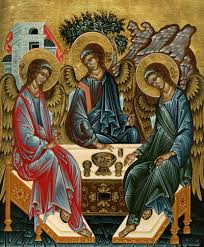
Sermon: Trinity C

I don't know why those in charge decided to designate one Sunday as "Trinity Sunday." Shouldn't every Sunday be "Trinity Sunday"? A celebration of the great mystery of the three-in-one, one-in-three God? As Christians we confess God to be Father, Son, and Holy Spirit, one God, three-persons, co-equal, co-eternal, one in essence, nature, power, action, and will. It's basic to what we believe as Christians.

But do we really know what that means or know why that's important? To the outsider it might look like a lot mental gymnastics, become theological contortionists, in order to justify a contradiction. 1+1+1 does NOT equal One. Volumes of books have been written trying to sort out the math. How can God really be three distinct persons, yet one God? It simply doesn't add up.

Other than Christ the King Sunday, Trinity Sunday is the day when we feel most tempted to keep God at a philosophical distance. We muse about the mystery of the Trinity. We try to do make the math work. On no other Sunday do most preachers do a weaker job connecting God to peoples' lives.

I think that's because we don't...(whole thing here)

Thursday, May 20, 2010

Book Review: Take Your Best Shot

Why do we expect so little from our youth? As a pastor, I often struggle to find meaningful ways of engaging our young people, to keep them interested and active in church. So, the church tries to keep our kids entertained, an extension of what they get elsewhere. Music they can relate to, games, retreats - and the occasional bible study or service project thrown in to keep our programming churchy.

But Austin Gutwein has shown in his book Take Your Best Shot: Do Something Bigger Than Yourself that young people care about the world that God made and are eager to provide meaningful solutions to human suffering. Young people have both the compassion and the know-how to alleviate the agony of others.

Challenged by a World Vision video telling the story of an AIDS Orphan in Zambia named "Maggie" (He calls this his "Maggie Moment"), 9-year-old Austin Gutwein was moved to help her, and others like her. After sharing his concern with a World Vision staffer who told him to "...use basketball to change the world" Austin Gutwein decided to raise money by shooting free-throws. Since there were 2057 children orphaned by AIDS each day, he would shoot 2057 free throws, at a dollar per throw (but not basket).

Of course, he reached his goal. And later he decided to try it again, this time with 1000 people shooting free throws. And "Hoops of Hope" was born.

What I found unique about his story wasn't his success (which made for a good read) but his ability to reflect on what God was doing throw him. He was able to integrate biblical passages about the poor and suffering into his work with AIDS orphans in way that wasn't trite or condescending. Too often, these stories have a "isn't it so great that we wealthy North Americans can help these poor, underdeveloped Africans" feel to them. Not this book. For young Austin Gutwein, it's a story of one kid just trying to help other kids, because that's what Christians do.

But as a parent and a pastor, this book was a challenge to expect more from the young people under my care, to help them grow and push their limits. Youth do not need more entertainment, especially not from churches. Young people need to know that they have gifts and passions that can help change the lives of others. For me, Austin Gutwein's book was a helpful reminder that everyone plays an important leadership role in God's unfolding kingdom. This book would make an excellent gift for the young person in your life who is struggling to find his/her place in church and the world. It is a wonderful affirmation of the giftedness of all God's people.


(Book has been provided courtesy of Thomas Nelson and Graf-Martin Communications, Inc. Available now at your favourite bookseller)

Thursday, May 13, 2010

Book Review: Hungry For Life

Blundell's book is no mere theological treatise or a biblical meditation on social problems. Hungry For Life is a manifesto. A call to arms for affluent North American Christians to live more faithfully and generously; using our resources to confront the horrible poverty most of the world lives in.

Blundell begins by showing us the problem of poverty, and the devastating effects it has on people in the developing world. And, he, boldly maintains, that affluent North American Christians are spiritually impoverished by their (our) lack of response to the needless suffering of our sisters and brothers around the world. The mark of faithful living, he says, is not how we worship or pray, but how we care for the poor.

He then moves on to the biblical foundations of his argument, expertly outlining how the core message of the bible is care for the poor as a faithful response to what God has graciously given us - life and salvation. He takes us through the hard words of the prophets, Jesus' commands, the Letter of James, and other passages to show that his basis for the Christian mission to alleviate the needless suffering poor has a deep biblical foundation.

He doesn't mince words. He's angry at the North American church for its spiritual complacency and calls for its radical renovation. He calls the church to repentence and transformation, not mere "behaviour modification" as he puts it. Nothing short of wholesale change will lift us from our spiritual impoverishment and a slavery to the sin of idolatry - "worshiping the God of money" as he puts it. He calls Christians to greater generosity as a response to the North American affluence that is keeping us spiritually malnourished. He calls us to a simpler lifestyle to confront our consumerist culture and free up resources for international development. He calls us to a greater prayer life where we lift up to God the concerns of the poor, and so we can connect to the source of all life. Blundell's vision is holistic.

But unlike most prophetic voices, he has a plan. He has crunched the numbers. He has formed an organization. He models what he preaches. He provides a framework for moving churches to action.

His book is a challenge. But his intent is to inspire Christians to action rather than make them feel guilty. His organization, Hungry For Life, from which the book drew its title works to connect congregations with communities in developing countries so churches can help where they're needed most, and develop life-changing relationships along the way.

Each chapter has a series of questions that help the reader dig more deeply into the material, which I found quite useful. And the final chapter and Appendices provide the answer to the "Now What?" question that people often ask after reading these types of books.

What surprised me about this book was that Blundell comes from an evangelical background. He's an ordained Christian & Missionary Alliance pastor and got his MA in International Non-Profit Leadership at Trinity-Western University. His evangelical credentials are solid.

But he spends little or no time talking about sharing the gospel with the poor. Which I found refreshing. Too often we think that the sole job of Christians is to lead people to Christ. We say that we need to spend more time preparing people for eternity rather than responding to bodily needs.

Blundell doesn't cover this disconnect. And his biblical exegesis might tacitly say why: there are a lot more passages about caring for those in need than about saving people for heaven.

What I would have liked more of was a broader discussion about what people in developing countries can teach us affluent North American Christians. I worry about the insidious paternalism that marks many development efforts, where the "poor" become objects, recipients of our generosity, rather than partners in creating a more sustainable world for all people. While Blundell doesn't give off this vibe, I was looking for more stories and examples about how those in developing countries develop mutual relationships with the churches with whom they connect.

For Blundell, North American church transformation can only occur when, with God's help, we re-orient ourselves away from our materialist culture and learn to live generously and sacrificially, responding to the cries of the poor, and learning from them along the way. This book should be read by every thoughtful Christian who longs for a church that connects more deeply to God and the world.

(NB: Book has been provided courtesy of the author and Graf-Martin Communications Inc. Available now at your favourite bookseller)

Monday, April 19, 2010

Can we please talk about numbers?


I was once asked:

If your church was given a million dollars with the stipulation that it was to be used for "missional outreach" how would your church spend it? Or a similar question: If God had suddenly sent 500 new members to your church, would you have the ministry infrastructure to integrate them into the life of the congregation?

Both of these questions were asked under the heading: "Be careful what you pray for."

Indeed.

For all my sound and fury about the need for more missional thinking and acting in the church, these questions made me realize that they signify nothing. I would have no idea what to do with a million dollars. 500 new members walking through the doors on one Sunday would be a ministry nightmare. 

But if you read the Book of Acts, you'll see that it's not as if such an event is without precedent.

It makes me wonder if our churches are designed NOT to grow. That they're designed for efficiency rather than growth. It's a truism in organizational theory that organizations are perfectly designed to achieve the results they're getting. And if churches are fighting off decline and losing, then maybe it's time to think about how we organize ourselves. We are declining, but we're very efficient about it.

I know, I know, we shouldn't even be talking about growing churches. I know the arguments: It's a surrender to the culture's consumerist ideology. Growth turns people into pawns. Ministry into a business. Pastors into CEOs. We follow Christ crucified, not corporate titans. Our job is to run the race, not to win it. We don't count noses, we bear fruit. We don't take attendance, we care for others. We are a prophetic people. A disciple community. A royal priesthood. A holy nation. We are in this world, but not of this world.

That true. As far as it goes.

And while numbers don't tell us everything, they do tell us something. Numbers tell us who is contributing to Christ's church. They tell us who God is calling into community. They tell us that all these unique, gifted, children of God have encountered the gospel, and that God is doing something in their lives, and using them for the growth of God's kingdom of justice, mercy, forgiveness, and peace.

Numbers = people. 

People = God's beloved children. Fellow workers in God's vineyard.

If churches are growing simply to build a "successful" ministry, then I want no part of it. But if churches are growing because they are making devoted followers of Jesus, fellow kingdom builders, co-workers with God in the New Creation, then count me in. And I say, the more the merrier.

Sunday, April 11, 2010

Sermon: Easter 2C

"The door was locked for fear of the Jews," the text says.

Maybe. But I’m sure there was more to it than that.

Yes, Jesus' disciples were probably afraid that their fellow Jews might have wanted to see them end on the business end of a cross. But that's probably not the only reason the door was locked. They might have been afraid of something - or someone - else. And they wanted to keep that person as far away as possible from them.

The announcement of Jesus' resurrection might not have been good news for the disciples. They knew what they had done. They knew that they scattered like scared rats when Jesus was arrested. Peter knew that he denied knowing Jesus while Jesus was being questioned and tortured by the police.

They knew that, while Jesus was hanging in torment waiting for death to take him, the only comforting eyes he saw were the women - and John.

Everyone else had disappeared when things started getting real.

They probably knew that their abandonment was just as painful to Jesus as the nails in his hands and feet. John says that the door was locked for fear of the Jews. But I wonder if the door was locked because it was one specific Jewish rabbi they were trying to keep out out.

They had heard that Jesus was back. And now they...(whole thing here)

Tuesday, April 06, 2010

Sermon: Easter Sunday


While much of the bible is, in fact, literary. I tend to believe the gospel writers were both reporting fact and telling a story. While it's not my intention to somehow "prove" the historical accuracy of the gospel stories, because I don't think that's their point. The point of the gospels is to bear witness to what God has done in their lives. And we can go back and forth, arguing over the evidence, offering solid proof for the resurrection's truthyness. But Luke doesn't do that. Luke just proclaims what has been reported to him. And he was probably convinced of the resurrection, not through rational argument, but through the changed behaviour of the disciples. Their lives bore witness to what they had seen. They had gone from grief to joy, from a crowd of scattered cowards to a courageous community. For among them, Christ has risen indeed. 

We hear that Easter is NOT just about a dead man opening his eyes. Easter is NOT just about our sins being forgiven. Easter is NOT just about the miracle of victory in the midst of defeat. 

Easter is about...(whole thing here)